Use the two graphs to find and . Does the two-sided limit exist? The marked open circles are excluded values.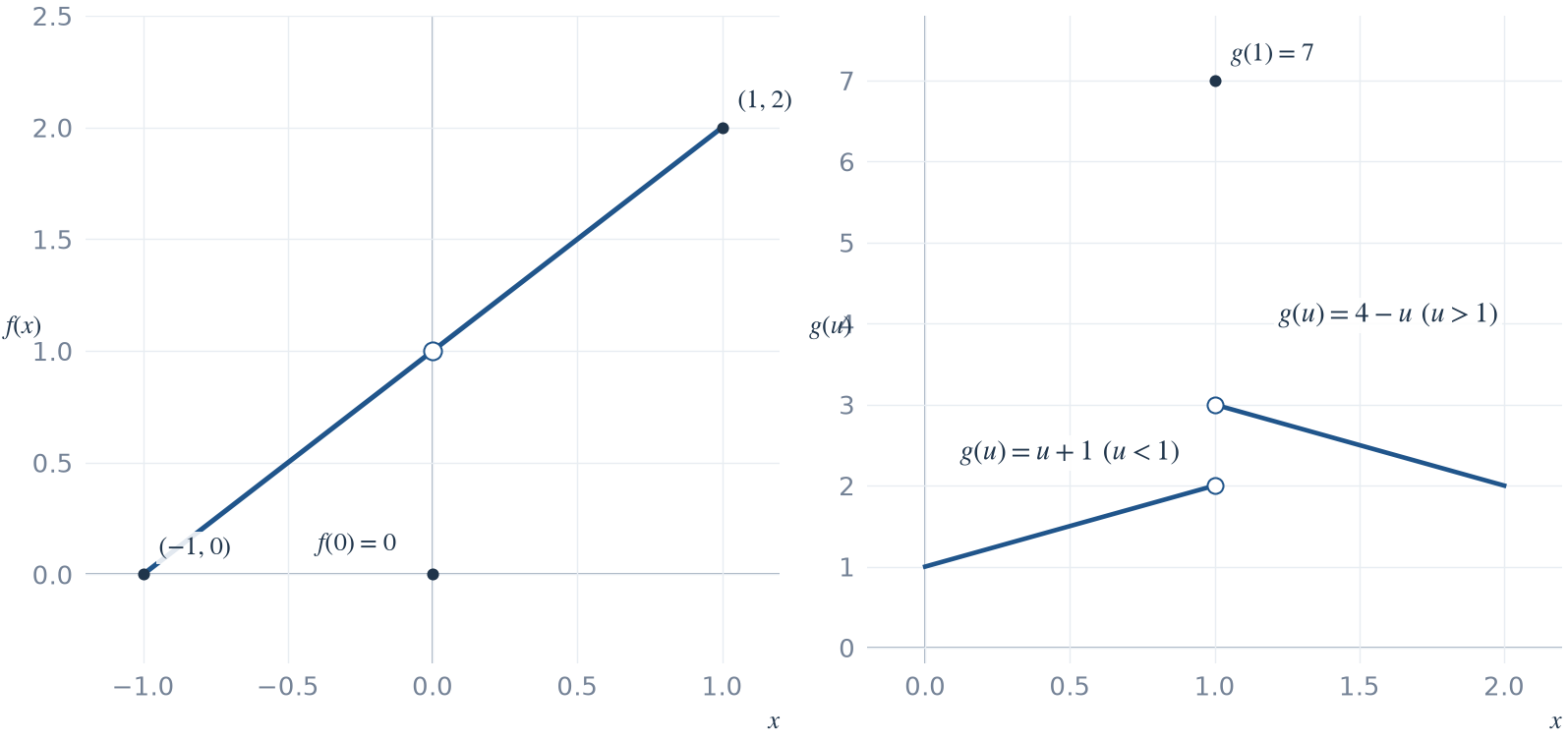
Focus line
University-level mathematics where the image carries information the text does not: function graphs, geometric figures, diagrams and plots. Each problem ships with its figure and a full solution.
Scale today1M+ problems
Target10M
ModalityImage + text
FormatJSONL + PNG
01Why this data
What makes it worth training on.
Expert-level difficulty
The figure is required to solve the problem, so text-only shortcuts fail.
Graduate & competition math: 1M+ problems →Training-ready on arrival
Questions reference their figures inline; images ship alongside the JSONL.
100% Markdown/LaTeX · schema-checked JSONL →02Sample
Inspect the data.
Real items from this line, shown exactly as delivered. Switch to JSON for the raw record, or download the public sample file.
Samples24 of 100
The one-sided limits are and , respectively. The two-sided limit does not exist.
From the inner graph, as and as . The outer graph has left limit and right limit at . The isolated values and do not determine these limits.
{
  "id": "ed65d411952414e55c0a5fe7",
  "subject": "Mathematics",
  "level": "Undergraduate",
  "qtype": "Short answer",
  "question": "Use the two graphs to find $\\lim_{x\\to0^-}g(f(x))$ and $\\lim_{x\\to0^+}g(f(x))$. Does the two-sided limit exist? The marked open circles are excluded values.\n<img src=\"images/e942f49b6281e1268106520dad6fc35a.png\">",
  "options": null,
  "answer": "The one-sided limits are $2$ and $3$, respectively. The two-sided limit does not exist.",
  "solution": "From the inner graph, $f(x)\\to1^-$ as $x\\to0^-$ and $f(x)\\to1^+$ as $x\\to0^+$. The outer graph has left limit $2$ and right limit $3$ at $1$. The isolated values $f(0)$ and $g(1)$ do not determine these limits.",
  "has_image": true
}03Coverage
How it is sliced.
Visual content
Function graphs, geometric constructions, region diagrams, plots and charts.
Levels
Undergraduate and above.
Alignment
Each question references its image explicitly; solutions reason over what the figure shows.
Also available
1M+ K–12 photo-based grading image-text pairs for answer-evaluation models.
04Schema
Record format.
| Field | Type | Description |
|---|---|---|
| id | string | Stable unique identifier. |
| subject | string | Discipline, e.g. Mathematics, Physics, Chemistry. |
| level | string | Undergraduate · Graduate · Competition. |
| qtype | string | Proof · Calculation · Short answer · Single / multiple choice · Fill-in-the-blank · True / false. |
| question | string | Problem statement in Markdown with LaTeX. |
| question → <img> | image ref | Inline reference to a PNG figure shipped with the JSONL. |
| options | array | null | Answer options for choice questions. |
| answer | string | Final answer, verifiable where the question type allows. |
| solution | string | Full step-by-step reasoning. |
| has_image | bool | True for every item in this line. |
05Use
Built for.
- Multimodal reasoningTrain vision-language models to read a figure and reason from it.
- Image-text alignmentProblems where text and image must be understood together.
- EvaluationVisual math sets where text-only shortcuts fail.
Contact
Request a pilot slice.
Tell us the multimodal math slice you need. We will send a pilot sample cut to your specification for your own evaluation.